New Age Spots vs Sun Spots: Causes & Treatment Options | ME MEDSPA blog Post
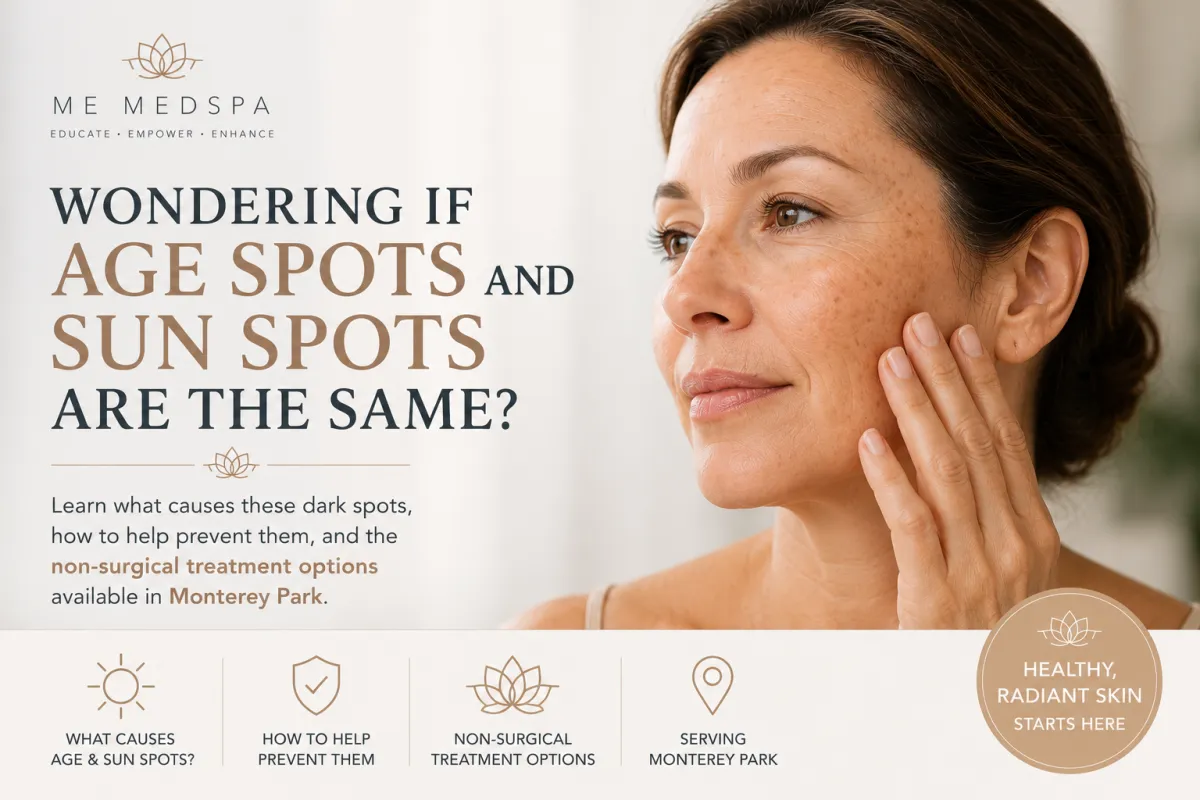
Age Spots vs Sun Spots: What's the Difference and Can They Be Treated?
Have you noticed small brown spots appearing on your face, hands, shoulders, or chest?
Many people assume these spots are simply a normal part of getting older.
Others call them sun spots, while some know them as liver spots.
So which name is correct?
The answer is that these terms are often used interchangeably because they usually describe the same type of pigmentation caused primarily by years of ultraviolet (UV) exposure.
Although age spots become more common as we grow older, aging itself isn't the direct cause.
Instead, repeated exposure to ultraviolet radiation gradually increases melanin production in certain areas of the skin, creating flat brown spots that become more noticeable over time.
Understanding why these spots develop can help you make informed decisions about sun protection, skincare, and professional treatment options.
In this guide, we'll explain the differences between age spots and sun spots, what causes them, how to help prevent them, and when professional evaluation may be appropriate.

Are Age Spots and Sun Spots the Same Thing?
In most cases, yes.
The terms age spots, sun spots, and liver spots are commonly used to describe the same type of benign pigmentation.
Medical professionals often refer to them as solar lentigines.
These flat brown spots commonly appear on areas that receive frequent sun exposure, including:
Face
Hands
Shoulders
Chest
Arms
Unlike freckles, age spots usually do not fade during winter months because they develop after years of cumulative UV exposure.
Although these spots are generally harmless, any new, changing, irregular, painful, or bleeding skin lesion should always be evaluated by a qualified healthcare professional to rule out skin cancer or other medical conditions.

What Causes Age Spots?
Age spots develop when repeated ultraviolet exposure stimulates melanin-producing cells within the skin.
Over many years, this excess melanin becomes concentrated in certain areas, creating flat brown patches.
Several factors increase the likelihood of developing age spots.
Long-Term Sun Exposure
Repeated UV exposure remains the most significant contributor.
If you'd like to understand how ultraviolet radiation affects collagen and overall skin aging, read our guide:
How Sun Damage Speeds Up Skin Aging (And What You Can Do to Protect Your Skin)
Natural Aging
Although UV exposure plays the biggest role, these spots become more common later in life because cumulative sun exposure increases over time.
If you'd like to understand why skin changes naturally as we age, read:
Why Skin Ages After 30: Understanding Collagen Loss & How to Slow It Naturally
Genetics
Some individuals naturally develop pigmentation more easily than others.
Family history may influence both the number of spots and when they first appear.
Skin Type
People with lighter skin tones often develop visible solar lentigines more readily after years of sun exposure.
However, age spots can occur in individuals of many different skin tones.

How Are Age Spots Different from Melasma or Freckles?
Not every brown spot is an age spot.
Understanding the differences helps explain why treatment recommendations vary.
Age Spots
Usually appear after years of sun exposure
Flat brown patches
Common after age 40
Often found on sun-exposed areas
Freckles
Usually appear earlier in life
Often fade with less sun exposure
Strong genetic influence
Melasma
Often linked with hormonal changes
Frequently appears on both cheeks, forehead, and upper lip
Can worsen with sunlight
Because different pigmentation concerns have different causes, obtaining an accurate diagnosis is important before pursuing cosmetic treatment.

Can You Prevent Age Spots?
Although it isn't always possible to prevent every age spot, protecting your skin from ultraviolet exposure can reduce additional sun damage over time.
Helpful habits include:
Applying broad-spectrum SPF 30 or higher every day
Wearing wide-brimmed hats outdoors
Reapplying sunscreen every two hours during prolonged outdoor exposure
Wearing UV-protective clothing
Avoiding indoor tanning beds
Daily sun protection also supports healthier skin by helping reduce cumulative photoaging.

Can Age Spots and Sun Spots Be Treated?
Yes. Many age spots can be faded or removed, but treatment should begin with confirming that the pigmentation is actually a benign sun spot.
Not every brown mark is an age spot. Melasma, post-inflammatory hyperpigmentation, seborrheic keratoses, actinic keratoses, and certain skin cancers can sometimes resemble ordinary pigmentation.
Before treating a spot, seek medical evaluation when it is:
New or changing
Asymmetrical
Irregularly bordered
Uneven in color
Growing rapidly
Itchy, painful, crusting, or bleeding
A dermatologist should evaluate anything unusual before cosmetic treatment. Changes in a spot’s size, shape, color, elevation, or symptoms may require prompt examination.
Once the diagnosis is confirmed, the appropriate treatment depends on the depth of the pigment, skin tone, treatment area, medical history, and desired outcome.
Professional Treatment Options for Age Spots
Professional treatments generally fall into two categories:
Topical medications and skincare products
In-office procedures
Creams often require consistent use over several weeks or months, while procedures may work more quickly but can involve greater cost, downtime, and risk of side effects.
Laser and Light-Based Treatments
Certain laser and light devices target excess pigment within the skin.
Depending on the technology, energy is absorbed by the pigment, allowing the treated spot to gradually darken, break apart, or fade as the skin recovers.
Options used by qualified medical professionals may include:
Pigment-targeting lasers
Intense pulsed light
Q-switched lasers
Picosecond lasers
Certain fractional laser treatments
Research supports several laser and light-based approaches for solar lentigines, although results and risks differ between technologies and patients.
These treatments may not be appropriate for every skin tone. Patients with medium to deeper skin tones may have a greater risk of post-inflammatory hyperpigmentation or uneven lightening if the wrong device or settings are used.
A provider experienced in treating diverse skin tones should select the technology and treatment settings carefully.
Publishing note: Only present a specific laser or light procedure as an ME MEDSPA treatment if the practice currently offers that exact service.
Chemical Peels
Chemical peels use carefully selected solutions to exfoliate layers of the skin and encourage more even-looking skin renewal.
Depending on the peel’s formulation and depth, it may help improve:
Superficial sun spots
Uneven pigmentation
Dullness
Rough skin texture
General photoaging
Stronger peels involve more recovery and a greater risk of irritation or pigmentation changes.
Chemical peels should be selected according to the patient’s skin type, pigmentation pattern, sensitivity, and history of previous treatments.
Cryotherapy
Cryotherapy uses controlled freezing to destroy excess pigment-producing cells within an individual age spot.
It may be useful for isolated, clearly diagnosed solar lentigines, particularly on the hands or other sun-exposed areas.
Possible side effects include:
Temporary redness
Blistering or crusting
Lightening of the treated skin
Darkening after inflammation
Uneven pigmentation
The American Academy of Dermatology lists cryosurgery among the professional options that dermatologists may use to treat age spots.
Microdermabrasion
Microdermabrasion provides controlled superficial exfoliation.
It may help improve mild uneven texture and some superficial discoloration, but it is generally less targeted than pigment-specific laser treatments or medical chemical peels.
A series of sessions may be recommended depending on the skin concern.
Prescription and Professional Topical Treatments
Certain topical ingredients may gradually fade excess pigmentation by influencing melanin production or supporting skin-cell turnover.
Depending on the patient, a qualified professional may recommend ingredients such as:
Retinoids
Azelaic acid
Vitamin C
Cysteamine
Prescription lightening agents
Combination pigmentation formulas
Some stronger lightening ingredients can cause irritation or uneven pigmentation when used incorrectly. Hydroquinone, for example, is used medically for hyperpigmentation but is not approved for over-the-counter sale in the United States.
Patients should avoid purchasing unverified skin-lightening products online, especially products that do not clearly disclose their ingredients.

Can Over-the-Counter Skincare Fade Sun Spots?
Some nonprescription products may gradually improve mild discoloration, particularly when combined with daily sunscreen.
Common ingredients include:
Vitamin C
Niacinamide
Retinol
Alpha hydroxy acids
Azelaic acid
Licorice-root extract
Results are usually gradual and vary according to the cause and depth of the pigmentation.
Introduce active ingredients slowly. Combining several exfoliating acids, retinoids, and brightening products at once may cause irritation, and irritation can make pigmentation worse—especially in skin that is prone to post-inflammatory hyperpigmentation.
A simple routine may be more effective than an aggressive one.
Morning
Gentle cleanser
Antioxidant or brightening serum
Moisturizer
Broad-spectrum SPF 30 or higher
Evening
Gentle cleanser
Targeted pigment treatment, when appropriate
Moisturizer
Pregnant or breastfeeding patients should consult a qualified healthcare professional before using retinoids or prescription pigmentation treatments.
Why Sunscreen Is Essential During Treatment
Pigmentation treatment is unlikely to provide lasting improvement if the skin continues receiving significant unprotected UV exposure.
Daily sunscreen helps:
Reduce the formation of additional spots
Prevent treated pigmentation from becoming darker
Protect healing skin after procedures
Reduce cumulative photoaging
Support more even-looking results
Choose a broad-spectrum, water-resistant sunscreen with SPF 30 or higher.
Apply it generously to exposed areas, including:
Face
Ears
Neck
Chest
Hands
Arms
Reapply approximately every two hours when outdoors, as well as after swimming or heavy perspiration.
Regular sunscreen use helps protect against photoaging changes such as age spots, wrinkles, and sagging.
Where Do Morpheus8 and Skin Boosters Fit?
It is important not to describe every rejuvenation service as a direct age-spot treatment.
Morpheus8
Morpheus8 is primarily used to support collagen remodeling, firmness, and texture.
It may improve aspects of overall photoaged skin, such as:
Uneven texture
Fine lines
Mild skin laxity
Reduced firmness
However, Morpheus8 is not usually the primary treatment for isolated brown age spots.
A patient whose main concern is pigmentation may require a different or complementary treatment after the spots have been correctly diagnosed.
Skin Boosters
Skin Boosters focus primarily on hydration and overall skin quality.
They may help skin appear:
More hydrated
Smoother
More radiant
Healthier overall
However, Skin Boosters do not directly remove concentrated melanin from a solar lentigo.
They may complement a broader rejuvenation plan but should not be promoted as a stand-alone age-spot treatment.
Salmon DNA Facial
A Salmon DNA Facial may be incorporated into a plan focused on hydration, texture, and general skin rejuvenation.
As with Skin Boosters, it should not be described as a direct replacement for pigment-specific treatment.
A consultation can help separate the patient’s concerns into:
Pigmentation
Texture
Hydration
Fine lines
Skin laxity
This allows each concern to be addressed with an appropriate treatment strategy.
Can Age Spots Return After Treatment?
Yes.
Professional treatment may lighten or remove existing spots, but it does not erase the skin’s history of sun exposure or prevent new pigmentation from developing.
Age spots may return when:
The treated pigment was not fully cleared
The area continues receiving UV exposure
New spots develop nearby
Hormonal or inflammatory pigmentation is mistaken for an age spot
Maintenance may include:
Daily sunscreen
Protective clothing
Appropriate brightening skincare
Periodic professional treatments
Regular skin examinations
Long-term sun protection is essential for preserving results.
When Should You See a Dermatologist?
Schedule an evaluation when a spot:
Appears suddenly
Changes in size, shape, or color
Has an irregular border
Contains several colors
Looks different from surrounding spots
Bleeds, crusts, itches, or becomes painful
Continues growing
Does not respond as expected to treatment
Cosmetic treatment should never be used to conceal or remove an undiagnosed lesion.
A dermatologist can examine the area and may use dermoscopy or a biopsy when necessary to establish the diagnosis.
Age-Spot Consultations in Monterey Park
At ME MEDSPA, cosmetic recommendations should begin with understanding the concern being treated.
During a consultation, the team may evaluate:
The number and location of the spots
Skin tone and sensitivity
History of sun exposure
Previous pigmentation treatments
Current skincare products
Associated texture, hydration, or firmness concerns
Personal treatment goals
When a lesion appears medically suspicious or cannot be confidently identified as benign pigmentation, the patient should be referred to a dermatologist for evaluation before cosmetic treatment.
ME MEDSPA serves patients from:
Monterey Park
Alhambra
San Gabriel
Rosemead
East Los Angeles
Surrounding San Gabriel Valley communities
Related Reading
Continue learning about sun damage and healthy skin aging:
Frequently Asked Questions
Are age spots and sun spots the same?
In most cases, yes. Both terms commonly refer to solar lentigines—flat areas of excess pigmentation associated with cumulative UV exposure.
Why are age spots sometimes called liver spots?
“Liver spot” is an older, nonmedical name. These spots are not caused by the liver.
Are age spots dangerous?
Typical solar lentigines are benign. However, new, changing, irregular, painful, itching, crusting, or bleeding spots should be examined by a dermatologist.
Can sunscreen make existing age spots disappear?
Sunscreen does not usually remove existing pigmentation, but it helps prevent spots from darkening and reduces the formation of additional sun damage.
Can skincare products remove sun spots?
Some topical ingredients may gradually fade mild pigmentation. Deeper or more persistent spots may require prescription products or professional procedures.
What is the fastest treatment for age spots?
Procedures such as certain lasers, light-based treatments, chemical peels, or cryotherapy may work faster than topical products. The safest choice depends on the diagnosis, skin tone, and treatment area.
Can age spots return after treatment?
Yes. Existing spots may recur, and new spots can form with continued UV exposure. Consistent sun protection helps maintain results.
Does Morpheus8 remove age spots?
Morpheus8 primarily targets collagen remodeling, texture, and firmness. It is not generally the first-line treatment for isolated brown age spots.
Book Your Consultation
Brown spots can have several different causes, and accurate identification is the first step toward choosing an appropriate treatment.
At ME MEDSPA, we can discuss your cosmetic concerns, evaluate your overall skin quality, and help determine whether professional rejuvenation options align with your goals.
Any spot that appears suspicious, unusual, or medically concerning should be evaluated by a dermatologist before cosmetic treatment.
Schedule a personalized consultation to discuss uneven skin tone, sun-related skin changes, and your options for healthier-looking skin.

