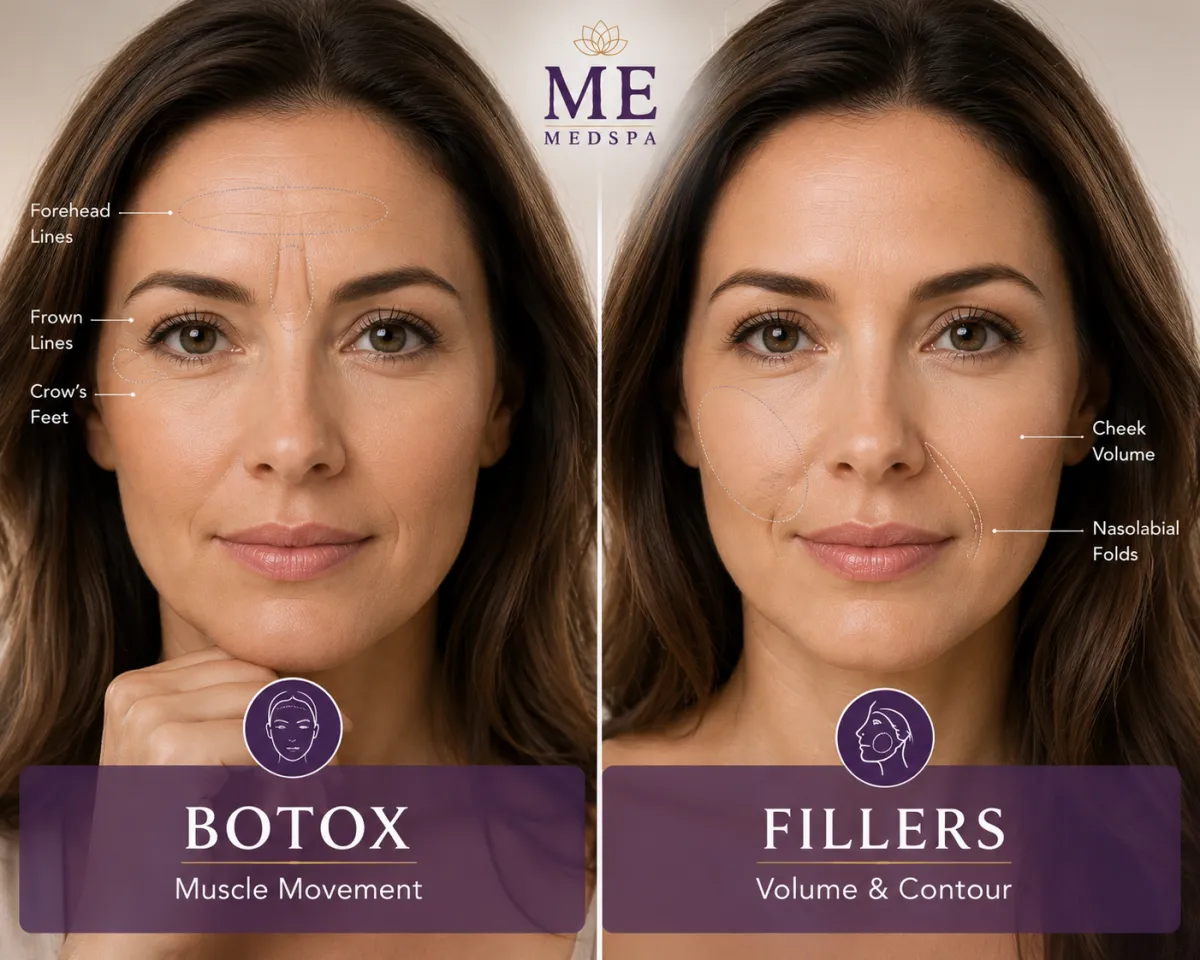
Botox vs Dermal Fillers | ME MEDSPA Monterey Park
Botox vs. Dermal Fillers: What’s the Difference and Which Injectable Is Right for You?
If you’re researching non-surgical facial rejuvenation, you’ve probably encountered two of the most familiar injectable treatment categories: Botox Cosmetic and dermal fillers.
They’re often mentioned together, but they are not interchangeable.
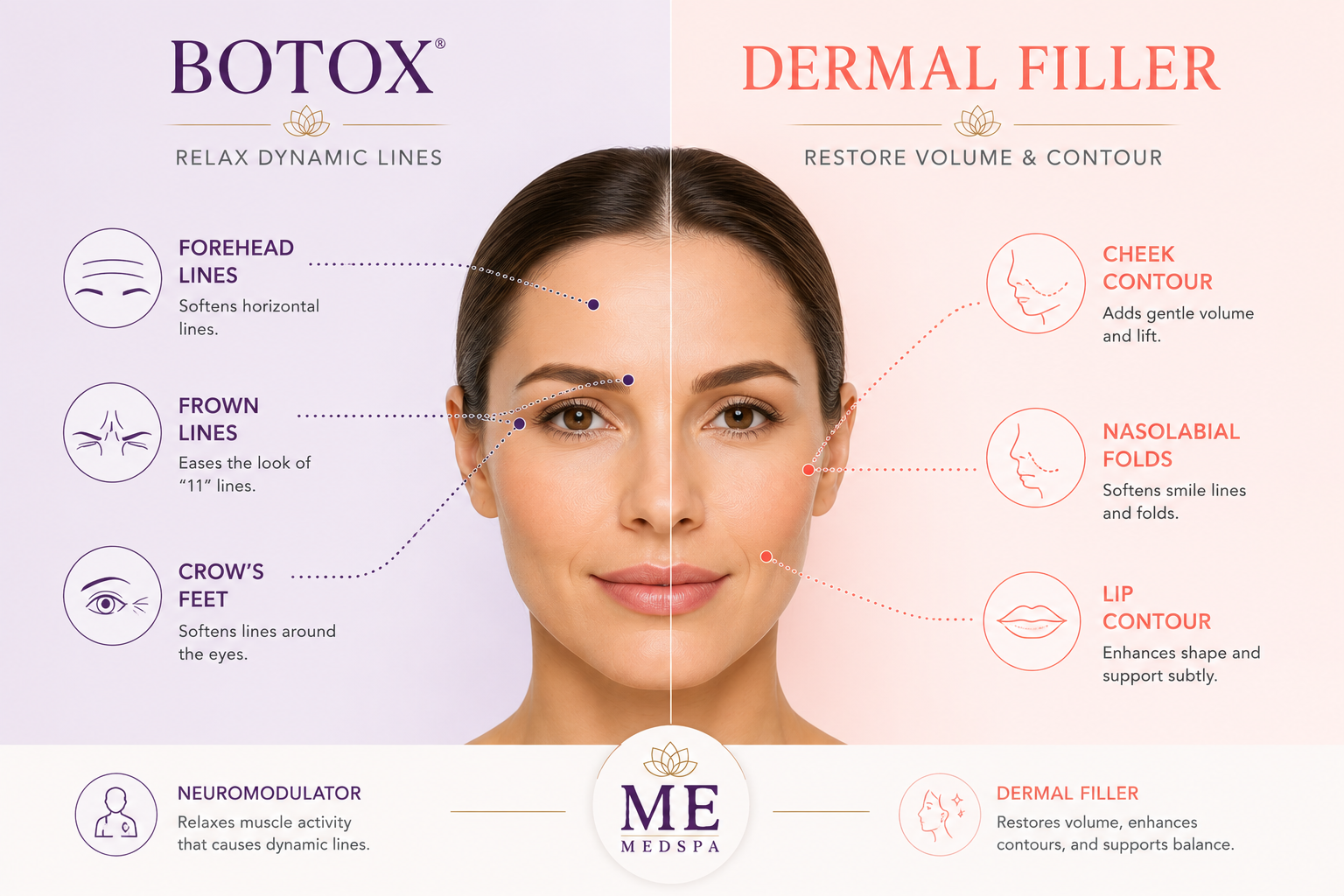
Botox Cosmetic is a prescription neuromodulator containing onabotulinumtoxinA. It temporarily reduces selected muscle activity that contributes to expression-related wrinkles. Current U.S. cosmetic labeling includes moderate to severe frown lines, crow’s feet, forehead lines, and platysma bands in adults.
Dermal fillers are injectable materials placed beneath the skin to restore or add volume, soften certain creases, enhance contours, or improve selected scars. Different fillers vary in composition, firmness, duration, approved treatment area, and intended use.
A simple way to understand the difference is:
Botox addresses selected muscle movement.
Fillers address volume, contour, or structural support.
However, facial aging is rarely that simple.
A person may have expression lines, lost cheek volume, deeper folds, skin laxity, and changes in skin quality at the same time. That means the right option—or combination of options—depends on what is actually creating the concern.
In this guide, we’ll explain how Botox and dermal fillers work, what each treatment can and cannot address, how their risks differ, and what to consider before choosing an injectable treatment.
What Is Botox Cosmetic?
Botox Cosmetic is a prescription botulinum toxin type A product containing onabotulinumtoxinA.
When injected into selected muscles, it temporarily reduces the nerve signals responsible for muscle contraction. As targeted muscle activity decreases, dynamic expression lines may appear softer.
Botox Cosmetic is commonly associated with concerns involving:
Frown lines between the eyebrows
Horizontal forehead lines
Crow’s feet around the eyes
Platysma bands in the neck
These are included in the product’s current U.S. cosmetic indications for adults.
Botox does not physically fill a wrinkle or add volume beneath the skin.
It also does not:
Restore hollow cheeks
Add lip volume
Replace lost facial fat
Remove pigmentation
Directly hydrate the skin
Correct every nasolabial fold
Its purpose is to reduce selected muscle activity temporarily.
This is why Botox tends to be most relevant when facial movement is a major contributor to the visible line.
For example, someone who notices crow’s feet mainly when smiling may require a very different treatment plan from someone whose main concern is hollow cheeks or deep folds around the mouth.

What Are Dermal Fillers?
Dermal fillers—also called soft-tissue fillers—are injectable materials placed beneath the skin to add volume, improve selected contours, soften certain facial creases, or address other approved cosmetic concerns.
The FDA explains that fillers may be made from different materials and approved for different treatment areas. These products are not all identical, and they should be used according to their labeling and by appropriately trained healthcare professionals.
Common filler materials include:
Hyaluronic acid
Calcium hydroxylapatite
Poly-L-lactic acid
Other approved soft-tissue filler materials
Different products vary in:
Thickness
Flexibility
Longevity
Injection depth
Treatment area
Intended outcome
For example, a softer filler may be selected for one area, while a firmer or more supportive product may be considered for another. The appropriate product and amount depend on the patient’s anatomy and treatment goals.
Dermal fillers may be used to address concerns such as:
Reduced cheek volume
Selected nasolabial folds
Lip volume or definition
Shallow facial contours
Certain scars
Other FDA-approved indications depending on the product
Fillers do not work by relaxing facial muscles.
Instead, they provide physical volume or structural support within the treated area.
Important Publishing Note
Only describe specific filler brands or treatment areas as available at ME MEDSPA if your clinic currently offers them.
Do not automatically add brand names such as Juvéderm®, Restylane®, Radiesse, or Sculptra® unless they appear on your live service list.
The Main Difference Between Botox and Fillers
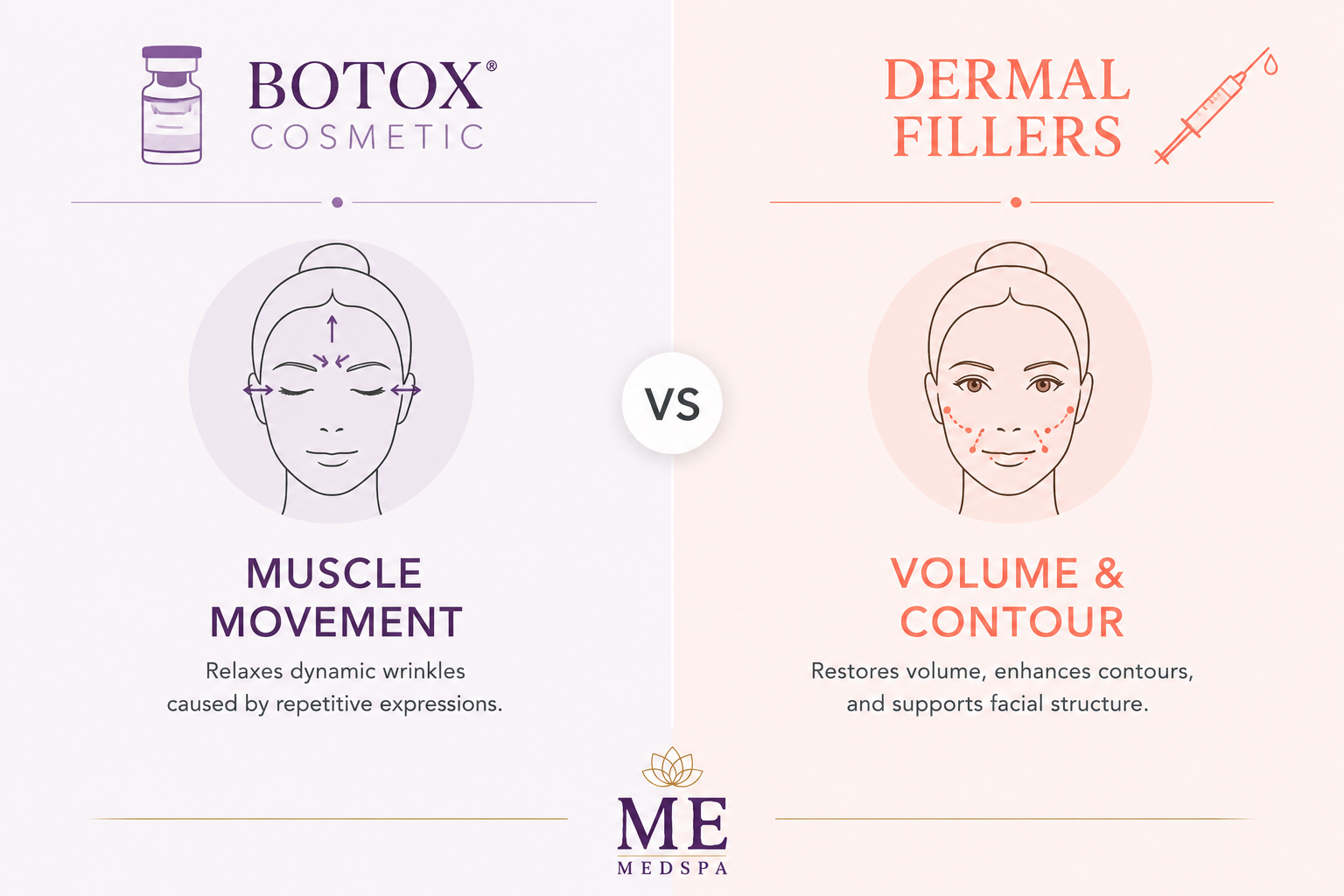
The most important difference is what each injectable is designed to change.
Botox Cosmetic
Botox temporarily reduces selected muscle activity.
It is generally associated with dynamic wrinkles caused or worsened by repeated facial movement.
Dermal Fillers
Fillers add or restore volume beneath the skin.
They are generally associated with concerns involving:
Facial volume loss
Selected facial folds
Contour changes
Lip volume
Structural support
The distinction can be summarized like this:
Botox Cosmetic Dermal Fillers Neuromodulator Volume-restoring or contour-enhancing injectable Targets selected muscle activity adds material beneath the skin often used for dynamic expression lines often used for volume loss and selected creases does not physically fill tissue does not primarily reduce muscle movement results are temporary results are temporary, with duration varying by product
Plastic-surgery guidance similarly distinguishes botulinum toxin treatments from fillers: botulinum toxin temporarily reduces selected muscle activity, while fillers are used to add volume and soften selected facial creases or contours.
Neither option is universally better.
The appropriate treatment depends on the cause of the concern.
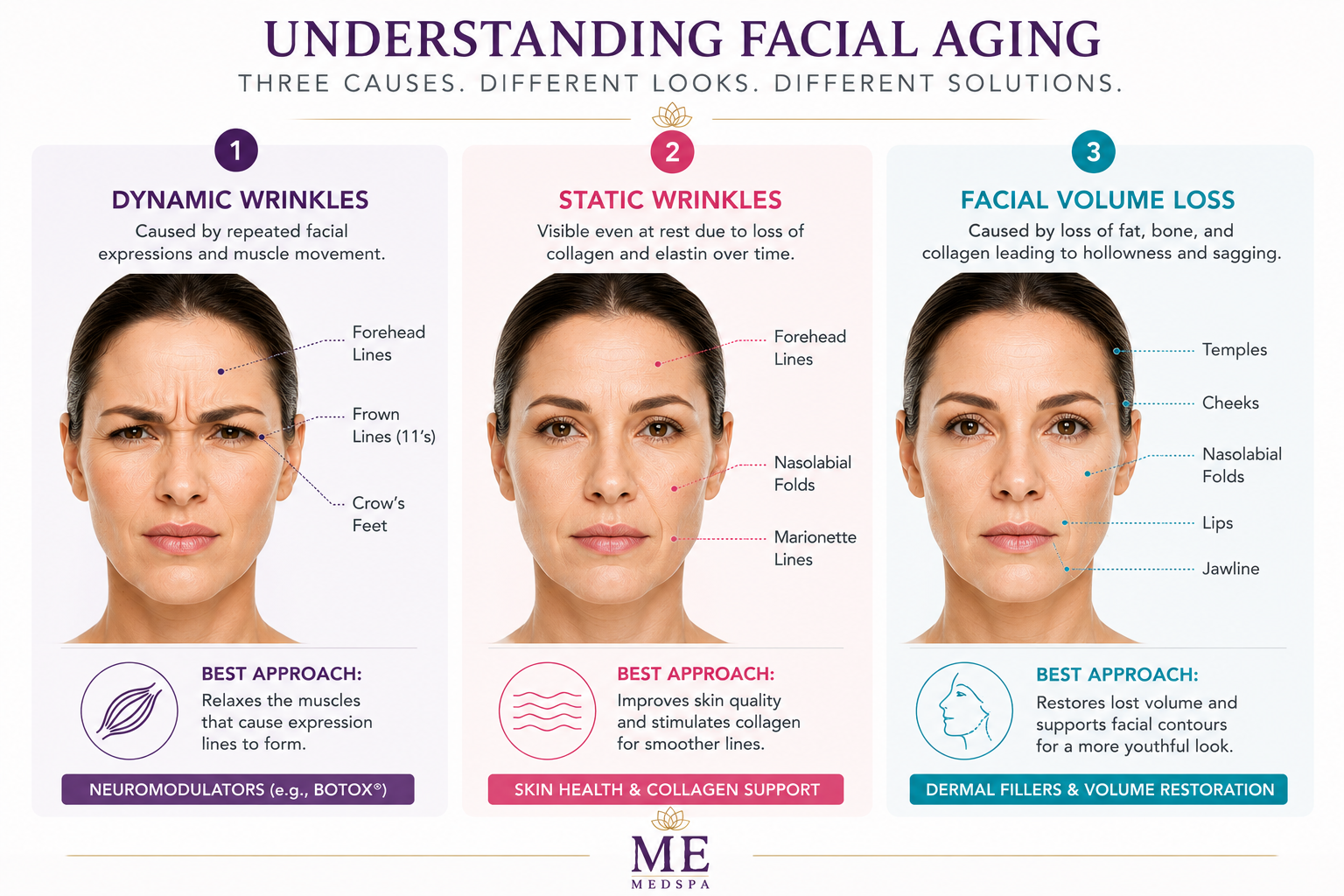
Dynamic Wrinkles vs. Static Wrinkles and Volume Loss
Understanding the type of concern is essential before choosing an injectable.
Dynamic Wrinkles
Dynamic wrinkles appear or deepen when facial muscles contract.
Examples include:
Frown lines while concentrating
Forehead lines while raising the eyebrows
Crow’s feet while smiling or squinting
Because movement contributes significantly to these lines, a neuromodulator may be considered.
Static Wrinkles
Static wrinkles remain visible while the face is relaxed.
They may be influenced by:
Long-term facial movement
Collagen decline
Sun exposure
Skin thinning
Reduced elasticity
Volume changes
A static wrinkle is not automatically a filler concern.
The provider must determine whether its appearance is driven mainly by skin quality, volume loss, facial movement, or several factors together.
Facial Volume Loss
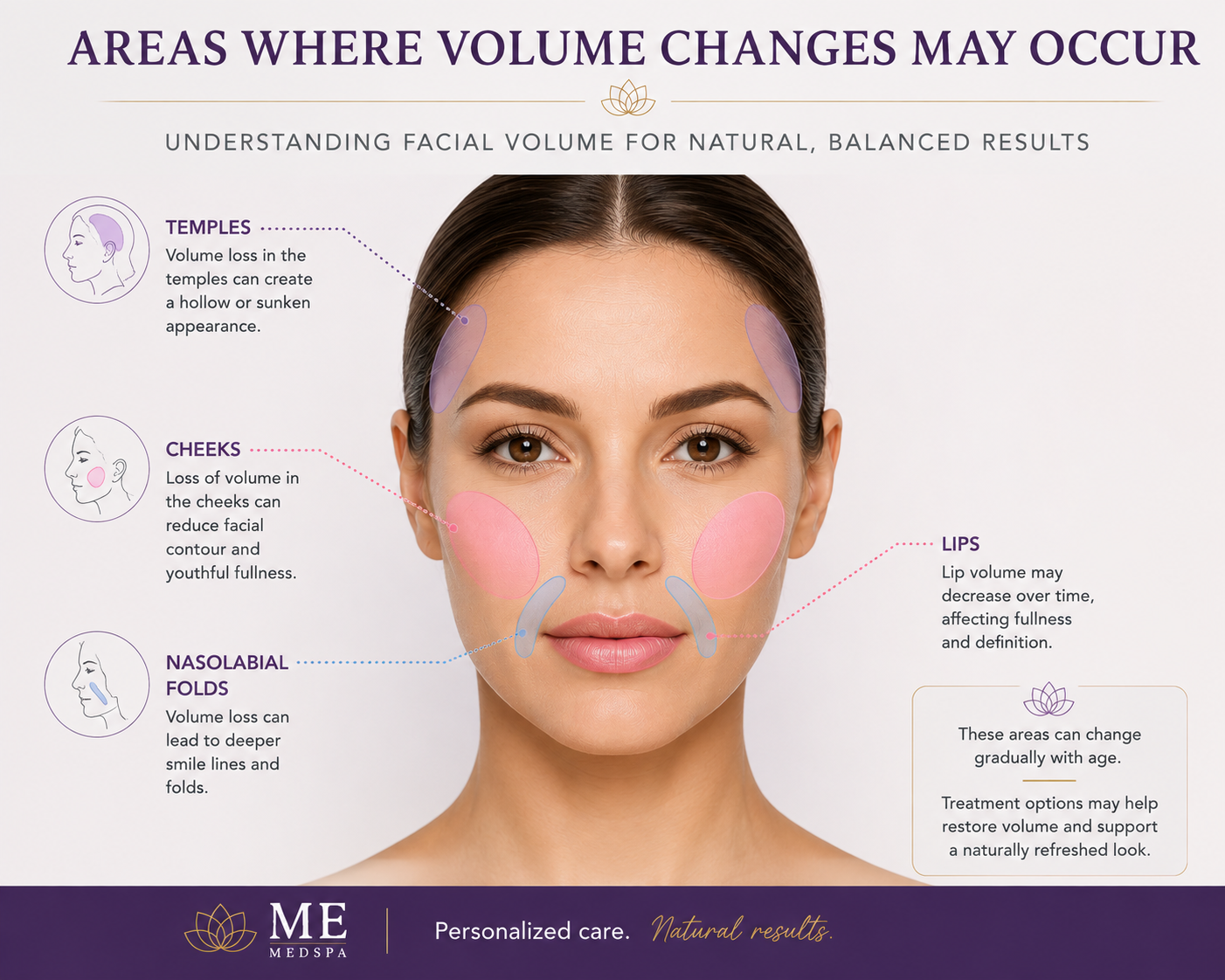
Volume loss changes the shape and support of the face.
It may appear as:
Hollow cheeks
Sunken temples
Under-eye hollowness
Reduced facial definition
Deeper folds around the nose and mouth
Dermal fillers may be considered for selected volume-related concerns, but treatment should be based on the patient’s full facial anatomy rather than simply injecting the most visible line.
If readers want a more detailed explanation of age-related volume changes, link to your published article:
Which Areas Can Botox Treat?
Under current U.S. cosmetic labeling, Botox Cosmetic may be used in adults for the temporary improvement of moderate to severe:
Glabellar or frown lines
Crow’s feet
Forehead lines
Platysma bands
Qualified healthcare professionals may sometimes discuss other areas based on clinical judgment, but patients should ask whether a proposed use is FDA approved or off-label.
The treatment plan should account for:
Eyebrow position
Eyelid anatomy
Muscle strength
Facial symmetry
Desired movement
Previous treatment response
The goal should not be to remove every facial expression.
A thoughtfully planned treatment aims to soften selected lines while preserving balanced movement.
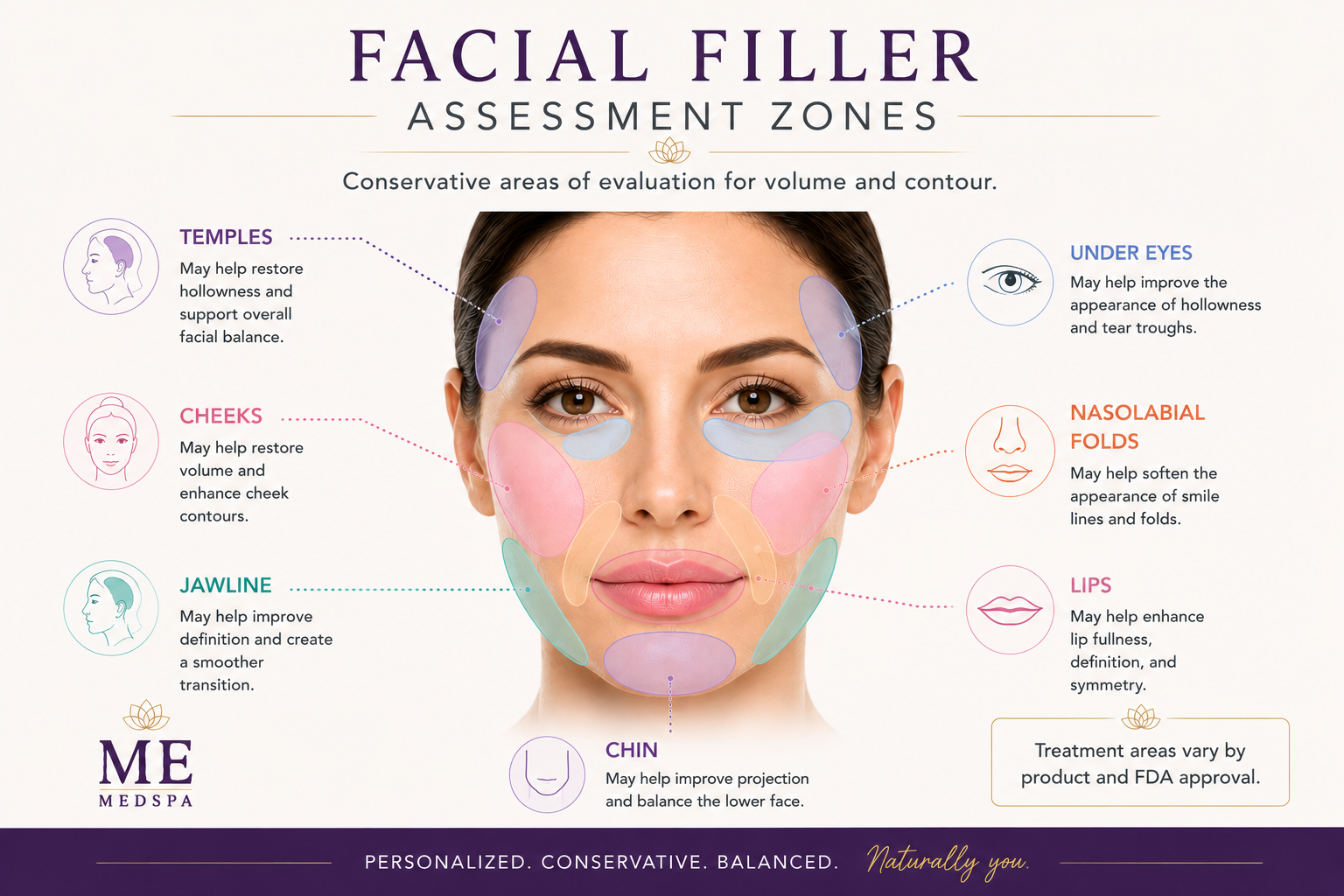
Which Areas Can Dermal Fillers Treat?
FDA-approved fillers have different labeled indications, so the exact treatment area depends on the specific product.
Depending on the filler, approved cosmetic uses may include selected areas involving:
Cheeks
Lips
Nasolabial folds
Chin or jawline contours
Certain wrinkles or scars
Back of the hands
The FDA advises patients to ask which filler is being used, where it is approved for injection, and what risks are associated with that product and treatment area.
A filler should not be selected solely because it is popular on social media.
The provider should evaluate:
Facial proportions
Existing asymmetry
Skin thickness
Degree of volume loss
Vascular anatomy
Previous filler
Desired result
Medical history
The same product may not be suitable for every area.
Important Safety Note
The FDA identifies accidental injection into a blood vessel as the most serious filler-related risk. It can cause tissue injury and, in rare cases, vision problems, stroke, or other severe complications. This is why filler treatment requires appropriately trained medical professionals with detailed knowledge of facial anatomy.
Botox vs. Fillers for Forehead Lines
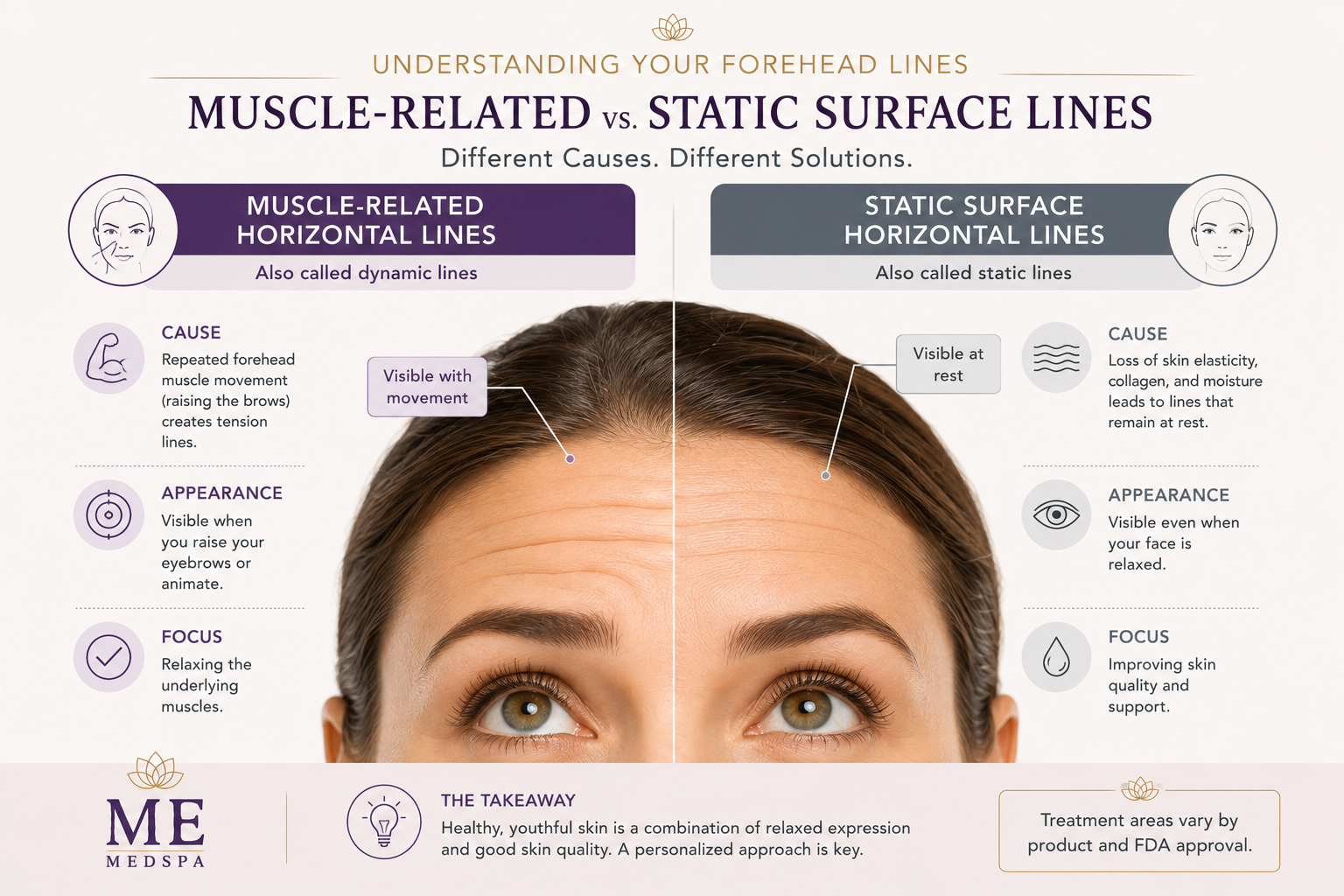
Horizontal forehead lines usually become more noticeable when the frontalis muscle lifts the eyebrows.
Because repeated muscle contraction is a major contributor, Botox Cosmetic is generally the more relevant injectable category for dynamic forehead lines. Botox temporarily reduces selected muscle activity rather than placing volume beneath the wrinkle. Its current U.S. cosmetic labeling includes moderate to severe forehead lines in adults.
Dermal filler is not usually the first treatment chosen for ordinary movement-related forehead lines.
The forehead contains important blood vessels, and filler injection in or near vascular structures can create serious complications. The FDA emphasizes that filler placement requires appropriate training, detailed anatomical knowledge, and careful patient selection.
A provider evaluating forehead lines should consider:
Whether the lines appear only during movement
Whether they remain visible at rest
Eyebrow position
Eyelid anatomy
Skin thickness
Existing asymmetry
Previous injectable treatment
Some static forehead lines may also reflect long-term collagen decline or sun damage. In those cases, a broader plan involving skincare or skin-quality treatments may be discussed rather than simply adding more injectable product.
Botox vs. Fillers for Crow’s Feet
Crow’s feet appear around the outer corners of the eyes and become more visible when smiling or squinting.
Because these lines are strongly influenced by movement of the muscles surrounding the eyes, Botox Cosmetic may be considered when the goal is to temporarily soften dynamic crow’s feet. Crow’s feet are included in Botox Cosmetic’s current U.S. aesthetic indications.
Dermal fillers are not generally used as a direct substitute for Botox in the outer eye area.
The skin near the eyes is delicate, and treatment around this region requires careful evaluation. Concerns involving under-eye hollowness, for example, are different from crow’s feet and may involve facial volume rather than muscle movement.
That distinction can be summarized as:
Lines appearing during smiling or squinting: neuromodulator evaluation may be appropriate.
Hollowness beneath the eyes: volume and facial-support assessment may be appropriate.
Thin, crepey texture: skin-quality treatment may be more relevant.
The visible location alone does not determine the right treatment. The underlying cause matters.
Botox vs. Fillers for Smile Lines and Nasolabial Folds
Smile lines and nasolabial folds are more complicated than forehead lines or crow’s feet.
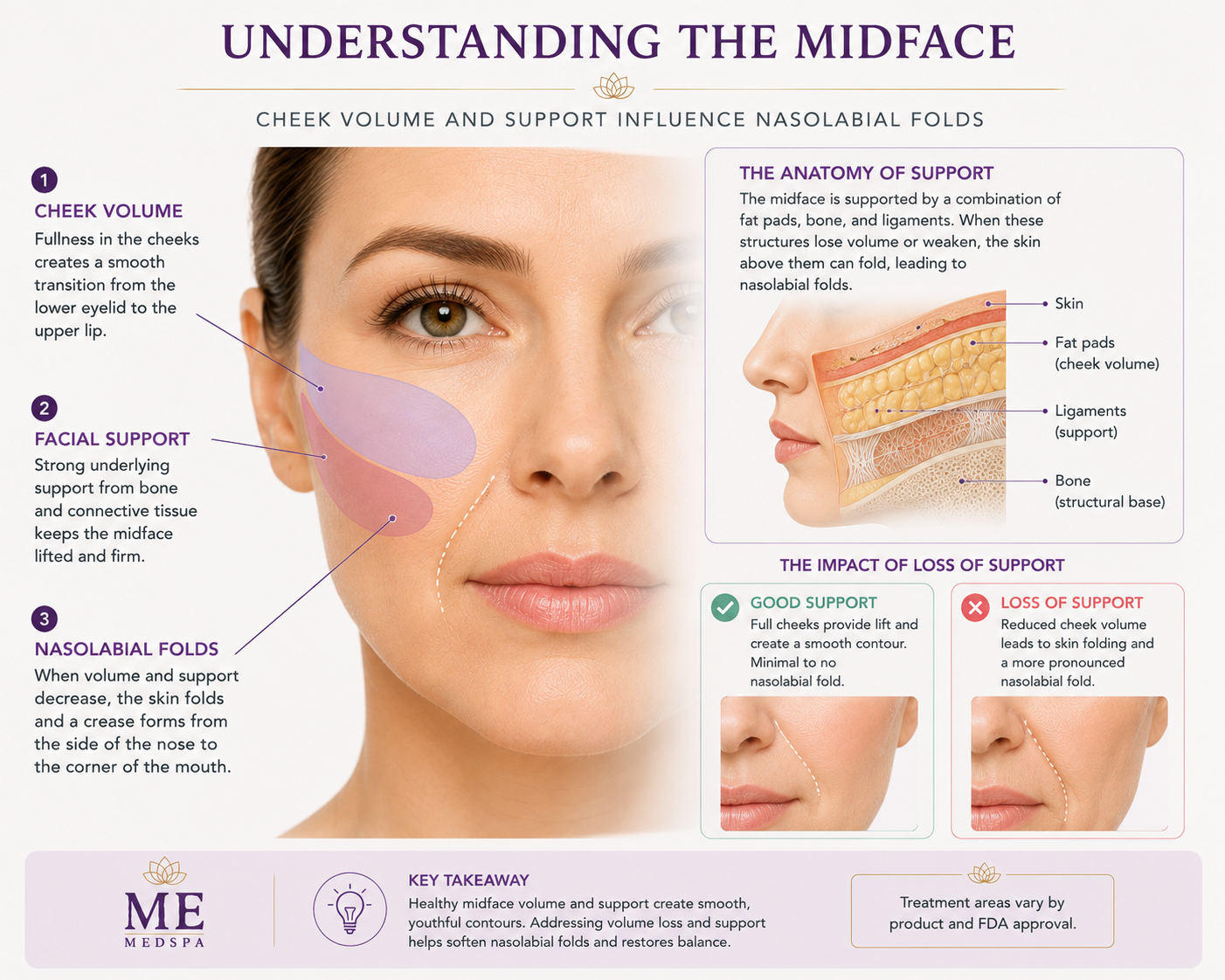
These folds extend from the sides of the nose toward the corners of the mouth. Their appearance may be influenced by:
Facial anatomy
Midface support
Facial volume changes
Skin elasticity
Collagen decline
Natural facial movement
Because deeper nasolabial folds often involve volume and structural support, dermal fillers may be evaluated for selected patients. FDA-approved fillers have product-specific indications, and some are approved for facial lines and folds such as nasolabial folds.
Botox does not physically restore volume within a nasolabial fold.
That does not mean every visible smile line requires filler. A thoughtful consultation should evaluate the cheeks, midface, skin quality, and overall facial balance rather than treating only the deepest part of the fold.
Botox vs. Fillers for Hollow Cheeks and Facial Volume Loss
Hollow cheeks are generally a volume-related concern rather than a movement-related wrinkle.
As facial fat compartments and supporting structures change with age, the cheeks may appear flatter, less supported, or hollower.
Dermal fillers may be considered for selected cheek-volume concerns depending on the product’s approved indication, the patient’s anatomy, and the provider’s assessment. Some FDA-approved fillers are designed to add or restore volume in specific facial areas.
Botox does not replace lost facial fat or add structural cheek support.
A cheek evaluation may include:
Midface fullness
Facial proportions
Existing asymmetry
Skin laxity
Degree of volume loss
Previous filler
Overall treatment goals
The objective should be balanced facial support—not simply adding the greatest possible amount of product.
Botox vs. Fillers for Lip Concerns
Botox and fillers may both be discussed for lip-area concerns, but they serve different purposes.
Dermal Fillers
Certain FDA-approved hyaluronic acid fillers may be used to temporarily add lip volume or improve selected perioral concerns, depending on the specific product’s labeling.
Fillers may be considered for goals involving:
Lip volume
Lip definition
Selected contour concerns
Certain lines around the mouth
Botox
Botox does not add lip volume.
Qualified providers may sometimes discuss off-label neuromodulator techniques for selected lip-area goals. Patients should be told when a treatment is off-label and should understand the expected benefits, limitations, and risks.
A patient asking for “bigger lips” and a patient asking for a subtle change in upper-lip movement are describing different goals and may require different approaches.
Botox vs. Fillers by Concern
Concern Botox Cosmetic Dermal Fillers Dynamic forehead lines Often considered Not usually first choice Frown lines Often considered Not usually first choice Crow’s feet Often considered Not usually a direct substitute Hollow cheeks Does not restore volume May be considered Nasolabial folds Does not physically fill the fold May be considered Lip volume Does not add volume May be considered with an appropriate product Facial contour support Limited role May be considered Muscle-related wrinkles Primary treatment category Does not reduce muscle activity Skin hydration Not a hydration treatment Depends on product and purpose
This table is a general educational guide, not a treatment recommendation.
The correct option depends on the patient’s anatomy, medical history, and the exact FDA-approved product being considered.
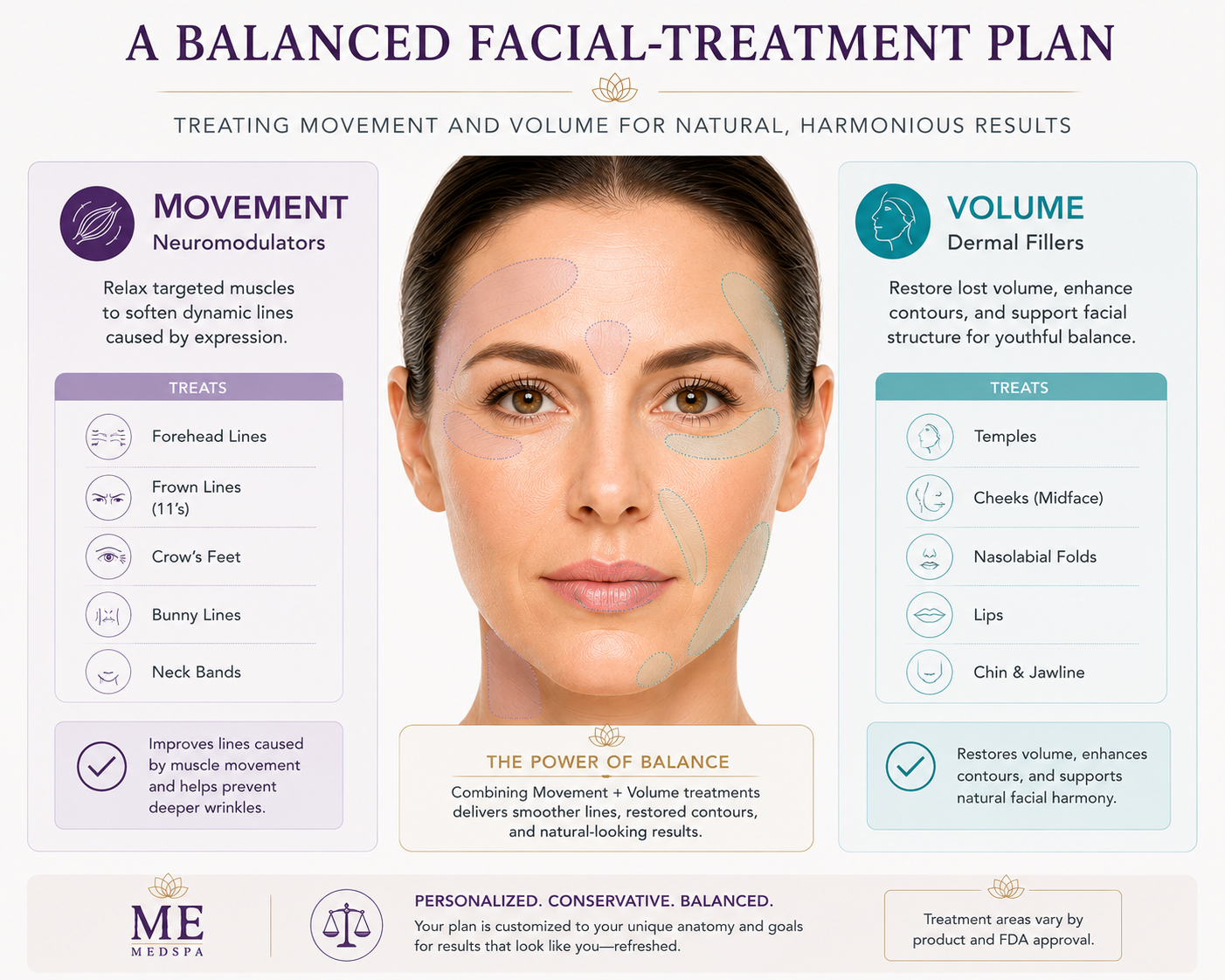
Can Botox and Dermal Fillers Be Combined?
Yes. Some patients receive both treatments as part of a personalized facial-rejuvenation plan.
They may be combined because they address different concerns:
Botox may soften selected movement-related wrinkles.
Fillers may restore volume or improve selected contours and folds.
For example, a patient might be concerned about both:
Frown lines caused by muscle activity
Age-related cheek-volume loss
Using one category of injectable would not necessarily address both concerns.
However, combination treatment does not mean every patient needs multiple injectables.
A provider should first determine:
Which concerns matter most to the patient
Whether the treatments should be performed together or in stages
Which products are appropriate
Whether the expected benefit justifies the risks
How previous injectable treatments affect the plan
More product does not automatically produce a more natural or more youthful result.
How Quickly Do Results Appear?
Botox Cosmetic
Botox results develop gradually as targeted muscle activity decreases.
Patients may begin noticing changes over several days, with the full effect developing later. The exact onset varies by individual, treatment area, and dose.
Dermal Fillers
Many fillers create an immediate visible volume change because material is physically placed beneath the skin.
However, the final appearance may take time to settle as temporary swelling improves.
Patients should understand that:
Immediate swelling can temporarily exaggerate the result.
Bruising may temporarily affect appearance.
Different products integrate differently into tissue.
The final assessment should not always be made immediately after injection.
Neither treatment should be judged solely by how it looks during the first few hours.
How Long Do Results Last?
Both Botox and fillers provide temporary results.
Botox Cosmetic
Duration varies with:
Treatment area
Muscle strength
Dose
Metabolism
Previous treatment response
Maintenance treatments may be considered as muscle activity gradually returns.
Dermal Fillers
Filler longevity varies more widely because it depends on:
Product material
Treatment area
Amount used
Facial movement
Individual metabolism
Product-specific characteristics
Some fillers are designed for shorter-term correction, while others may persist longer.
Patients should ask their provider:
Which exact filler is being used
How long that specific product commonly lasts
Whether it can be dissolved
What maintenance may involve
What happens if they dislike the result
Avoid making one universal duration claim for all fillers.
Recovery and Downtime
Botox Cosmetic
Common temporary effects may include:
Redness
Mild swelling
Tenderness
Bruising
Headache
Many patients return to normal daily activities soon after treatment, although they should follow their injector’s aftercare instructions.
Dermal Fillers
Temporary effects may include:
Swelling
Bruising
Tenderness
Redness
Firmness or small lumps
Temporary asymmetry while swelling settles
Recovery varies by product, area, and amount injected.
Lip filler often produces more noticeable temporary swelling than treatment in some other areas.
Patients should contact their provider if they develop concerning symptoms rather than assuming every reaction is normal.
Safety, Risks, and Possible Side Effects
Botox and dermal fillers have different risk profiles because they work differently.
Botox Cosmetic Risks
Botox Cosmetic is a prescription medication and carries a boxed warning regarding the possible spread of toxin effects beyond the injection area. Patients should seek immediate care for symptoms such as difficulty swallowing, speaking, or breathing.
Other possible effects may include:
Injection-site discomfort
Bruising
Headache
Temporary eyelid or eyebrow changes
Unwanted weakness in nearby muscles
Asymmetry
Dermal Filler Risks
Common temporary filler effects may include swelling, bruising, pain, tenderness, redness, itching, or firmness.
The FDA identifies accidental injection into a blood vessel as the most serious filler-related complication. It can lead to tissue injury and, rarely, vision impairment, stroke, or other severe harm.
Other risks can include:
Infection
Nodules or lumps
Allergic reactions
Migration
Delayed inflammation
Skin discoloration
Tissue damage
The FDA recommends using only approved fillers and avoiding needle-free filler devices, which do not provide sufficient control over product placement and have caused serious injuries.
Warning Signs After Dermal Filler Treatment
Patients should contact their injector immediately and seek urgent medical attention when instructed if they experience symptoms such as:
Severe or increasing pain
Skin that becomes unusually pale, gray, blue, or mottled
Sudden vision changes
Weakness, difficulty speaking, or other neurological symptoms
Rapidly worsening swelling
Signs of infection
These symptoms should not be managed solely through social media advice or home remedies.
Who May Not Be a Candidate?
Treatment may need to be postponed or avoided depending on the product and patient.
Potential concerns include:
Active infection or inflammation at the treatment site
Known allergy to product ingredients
Certain neuromuscular disorders
Bleeding disorders
Severe allergies or history of anaphylaxis
Pregnancy or breastfeeding, depending on medical guidance
Certain medications
Previous complications from injectables
The FDA specifically advises delaying filler treatment when the skin is actively inflamed or infected and notes that allergies, bleeding disorders, and some product ingredients may affect candidacy.
Patients should disclose:
All medications and supplements
Previous filler products
Previous botulinum toxin products
History of cold sores
Allergies
Dental procedures
Upcoming medical treatment
Previous injectable complications
Can Filler Be Dissolved?
Some hyaluronic acid fillers may be dissolved with an enzyme called hyaluronidase.
However:
Not every filler is made from hyaluronic acid.
Not every injectable can be dissolved.
Dissolving treatment carries its own considerations and risks.
Emergency management of vascular complications requires immediate professional care.
Patients should ask what product is being injected and whether it is reversible before treatment.
“Filler” is a category—not one single substance.
Common Myths About Botox and Dermal Fillers
Myth 1: Botox and Fillers Are the Same
Botox temporarily reduces selected muscle activity. Fillers add volume or structural support beneath the skin.
Myth 2: Botox Fills Wrinkles
Botox does not physically fill the skin. It targets muscle activity associated with selected dynamic wrinkles.
Myth 3: Fillers Always Make People Look Overfilled
Overfilled results are not inevitable.
Outcome depends on product selection, dose, placement, facial anatomy, and treatment goals.
Myth 4: Filler Is Risk-Free Because It Is Non-Surgical
Fillers are medical devices with possible complications, including rare but serious vascular injury.
Myth 5: Botox Is Only for Older Adults
Treatment is based on facial movement and individual concerns—not one universal age.
Myth 6: More Syringes or Units Mean Better Results
Appropriate treatment is based on anatomy and goals. More product can increase cost and may increase the risk of an unnatural or unwanted result.
Myth 7: One Injectable Treats Every Sign of Aging
Injectables do not replace:
Sun protection
Skincare
Skin-resurfacing treatments
Collagen-focused procedures
Surgical treatment when clinically appropriate
Botox and Filler Consultations in Monterey Park
At ME MEDSPA, injectable recommendations should begin with understanding what is creating the patient’s concern.
During a consultation, the provider may evaluate:
Facial movement
Static and dynamic wrinkles
Facial volume
Skin thickness
Facial symmetry
Existing filler
Skin laxity
Previous injectable response
Medical history
Desired result
A personalized plan may involve:
Botox Cosmetic
Dermal filler, when offered and appropriate
A staged combination
A different treatment category
No treatment at this time
The goal should be balanced, informed care—not automatically recommending injectables to every patient.
ME MEDSPA serves patients from:
Monterey Park
Alhambra
San Gabriel
Rosemead
East Los Angeles
Nearby San Gabriel Valley communities
Related Reading
Link only to live, relevant pages:
Crow’s Feet: Causes, Prevention & Best Treatments in Monterey Park
Smile Lines vs. Nasolabial Folds: Why They Get Deeper With Age
Frequently Asked Questions
What is the biggest difference between Botox and dermal fillers?
Botox temporarily reduces selected muscle activity associated with dynamic wrinkles. Dermal fillers add or restore volume beneath the skin.
Is Botox or filler better for forehead lines?
Botox is generally more relevant for forehead lines caused by muscle movement. Filler is not usually the first choice for ordinary dynamic forehead wrinkles.
Is Botox or filler better for smile lines?
Deeper smile lines and nasolabial folds may involve facial volume and support, so filler may be considered for selected patients. Botox does not physically fill these folds.
Can Botox and fillers be used together?
Yes. Some patients receive both because the treatments address different concerns. The plan should be individualized.
Which treatment has less downtime?
Both often involve limited downtime, but fillers may produce more noticeable swelling or bruising depending on the area and product.
Which lasts longer: Botox or filler?
Both are temporary. Botox duration varies by muscle and dose, while filler longevity varies significantly by product and treatment area.
Are dermal fillers reversible?
Some hyaluronic acid fillers may be dissolved with hyaluronidase, but not every filler is reversible.
Are fillers more dangerous than Botox?
They have different risks. Dermal fillers carry a rare but serious risk of accidental injection into a blood vessel, while Botox carries risks related to unwanted muscle effects and possible spread of toxin effect.
Schedule Your Consultation
Botox and dermal fillers are not competing versions of the same treatment.
They address different causes of facial aging:
Botox targets selected muscle activity.
Fillers address selected volume and contour concerns.
Choosing the right option begins with identifying what is creating the line, fold, hollow, or contour change.
At ME MEDSPA, we take a personalized approach to facial rejuvenation based on anatomy, movement, skin quality, medical history, and your desired result.
Schedule a consultation to learn which treatment category—or combination—may be appropriate for your goals.

