Sculptra vs. Dermal Fillers in Monterey Park, CA | ME MEDSPA
Sculptra vs. Dermal Fillers: What’s the Difference and Which Is Right for You?
If you're considering an injectable treatment for facial aging, volume changes, or wrinkles, you've probably encountered both Sculptra and dermal fillers.
They are often discussed together, but they aren't interchangeable.
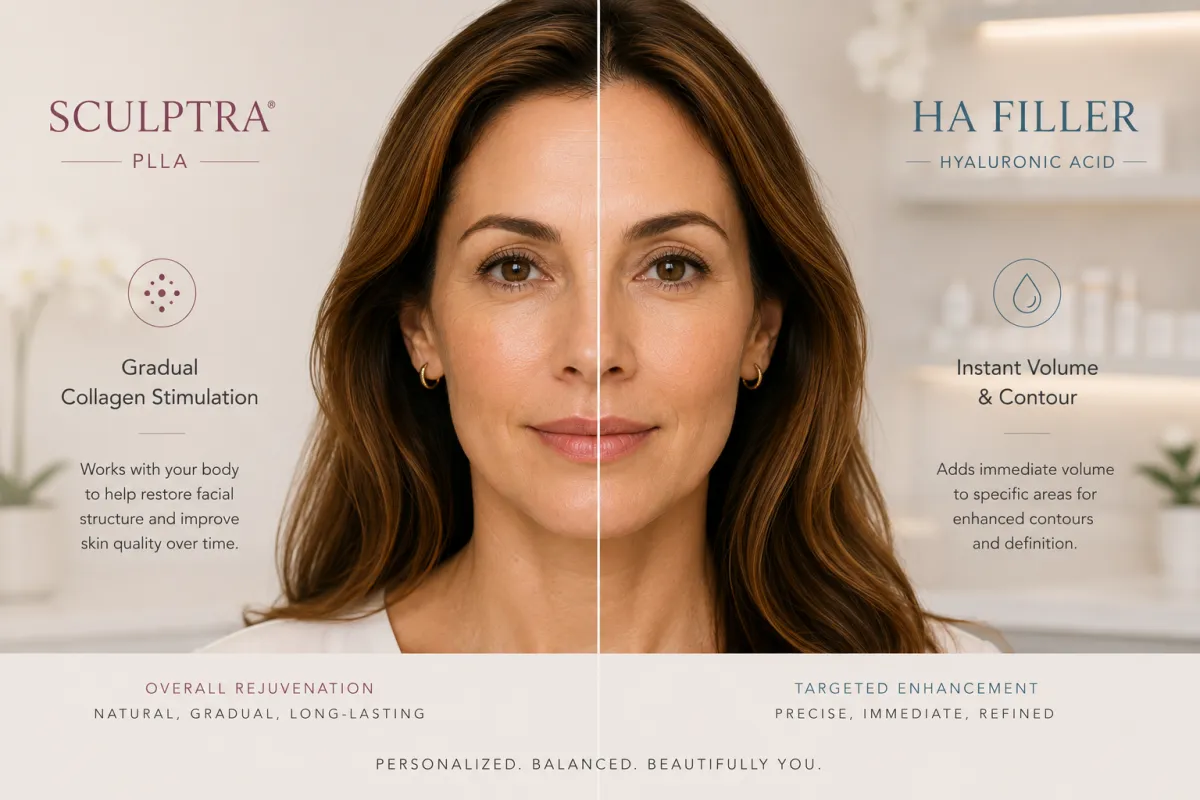
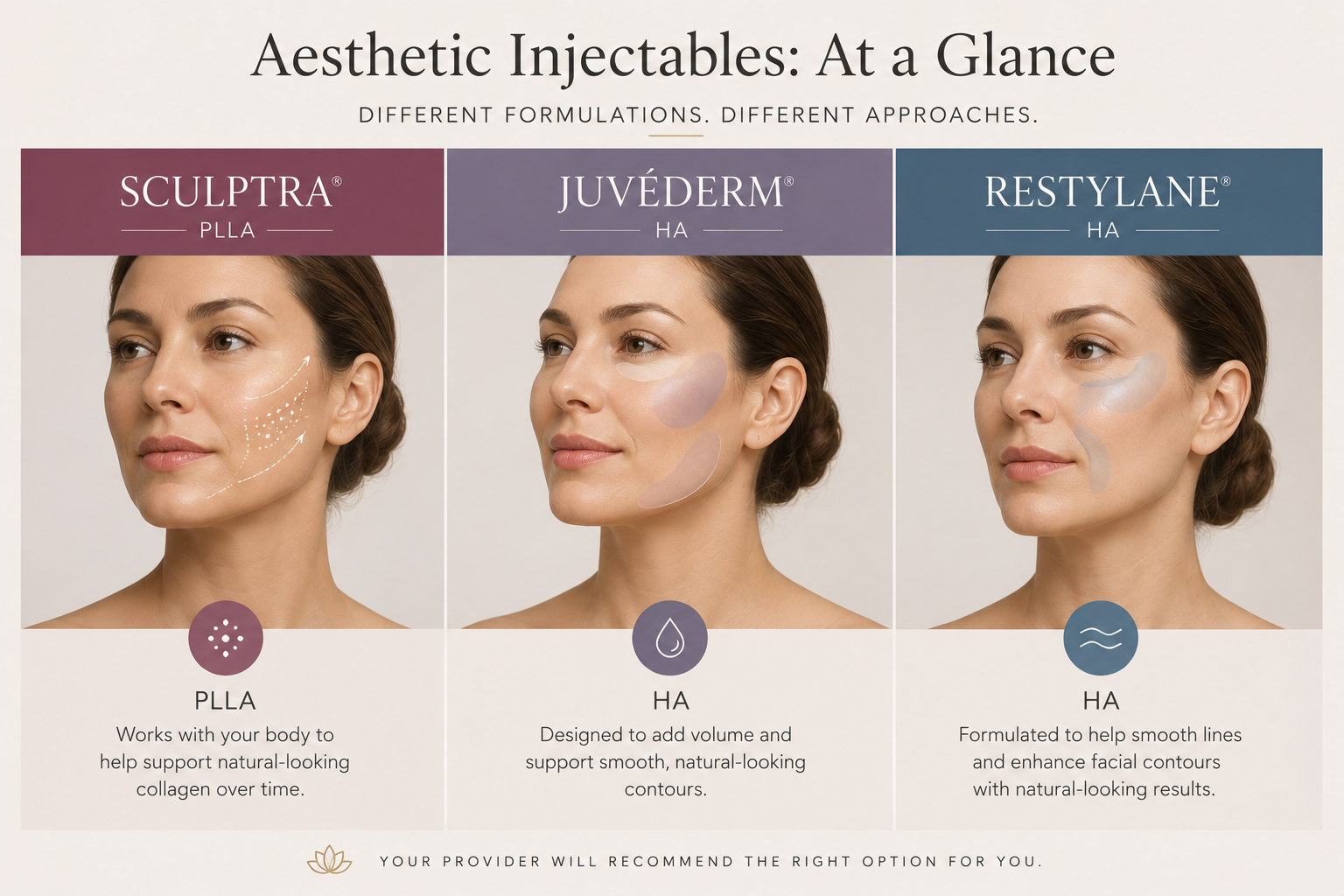
Many commonly used dermal fillers contain hyaluronic acid (HA) and create a filling or smoothing effect by placing injectable gel in selected facial tissue. Sculptra contains poly-L-lactic acid (PLLA) and its cosmetic effects become increasingly apparent over time rather than functioning exactly like an HA gel filler. The FDA describes PLLA effects as developing over several weeks and potentially lasting up to two years.
At ME MEDSPA in Monterey Park, CA, choosing between Sculptra and another dermal filler should begin with your anatomy, the area you want addressed, your medical history, previous treatments, and the type of cosmetic change you're hoping to achieve.
What Is Sculptra?
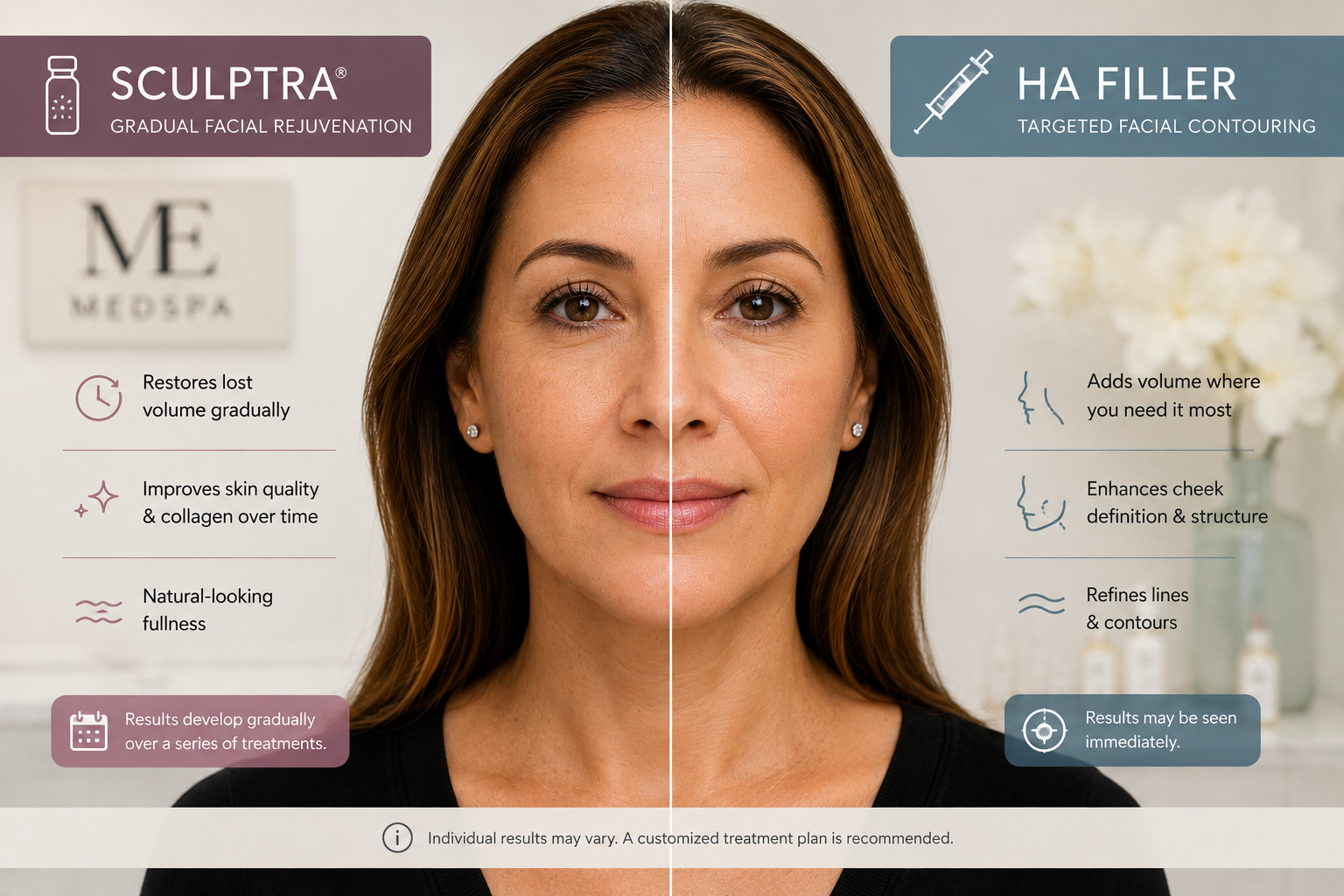
Sculptra is an injectable product made with poly-L-lactic acid (PLLA).
Unlike an HA filler that provides a gel-based filling effect in the injected area, PLLA is a biodegradable synthetic material whose cosmetic effect becomes increasingly apparent over time. The FDA classifies PLLA among absorbable filler materials.
Sculptra's current FDA-approved aesthetic indication includes the correction of fine lines and wrinkles in the cheek region in immune-competent adults.
That distinction matters because Sculptra should not be presented as FDA-approved for every facial or body area in which injectable treatments may be discussed.
For patients considering Sculptra, treatment planning should account for the approved indication, any proposed off-label use, anatomy, desired outcome, and potential risks.
What Are Dermal Fillers?
“Dermal filler” is a broad category rather than one single product.
The FDA regulates dermal fillers as medical devices. Depending on the specific product, approved fillers may be used for selected facial wrinkles and folds or augmentation of areas such as the lips, cheeks, chin, under-eye hollows, jawline, and back of the hand. Individual products have their own specific approved indications.
Several filler materials exist, including:
Hyaluronic acid (HA)
Poly-L-lactic acid (PLLA)
Calcium hydroxyapatite
Polymethylmethacrylate (PMMA)
When people casually compare “Sculptra vs. filler,” however, they often mean Sculptra vs. an HA filler such as certain Juvéderm or Restylane products.
HA is naturally present in body tissues and can combine with water. When formulated as an injectable gel, it creates a smoothing or filling effect.
What Is the Main Difference Between Sculptra and HA Fillers?
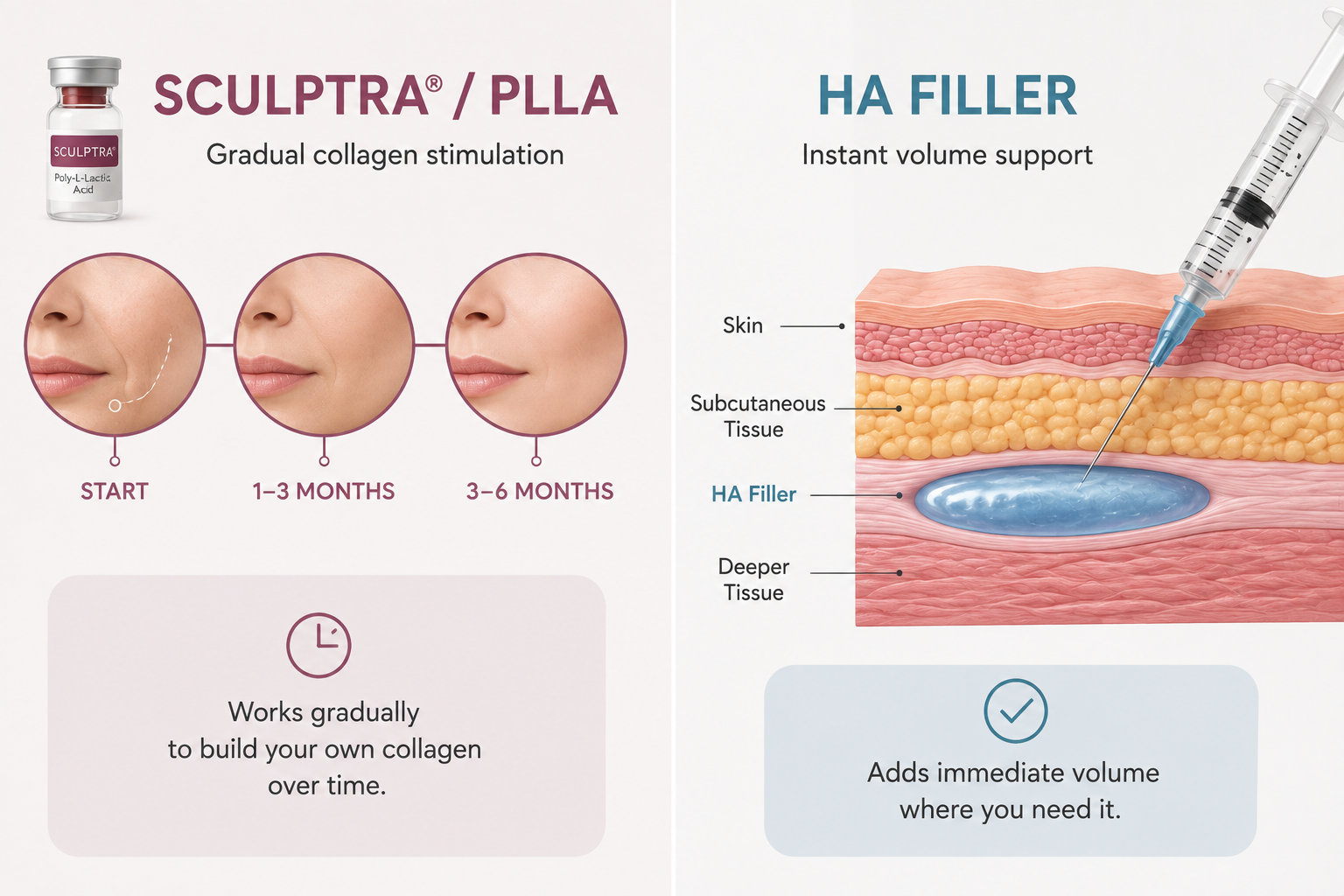
The biggest practical difference is how the cosmetic change develops.
Sculptra
Sculptra's PLLA-based effect develops progressively rather than producing the same type of immediate gel-filling effect associated with HA filler.
The FDA notes that PLLA effects generally become increasingly apparent over several weeks.
Hyaluronic Acid Fillers
HA fillers are gels injected into selected tissue to create a smoother or fuller appearance.
Because the material itself provides volume, the filling effect can be apparent much sooner, although swelling immediately after injection can temporarily affect how the area looks.
So, in simplified terms:
Sculptra → gradual cosmetic change
HA filler → more immediate filling/contouring effect
This distinction is one of the most important considerations when deciding between the two.
Is Sculptra a Collagen Stimulator?
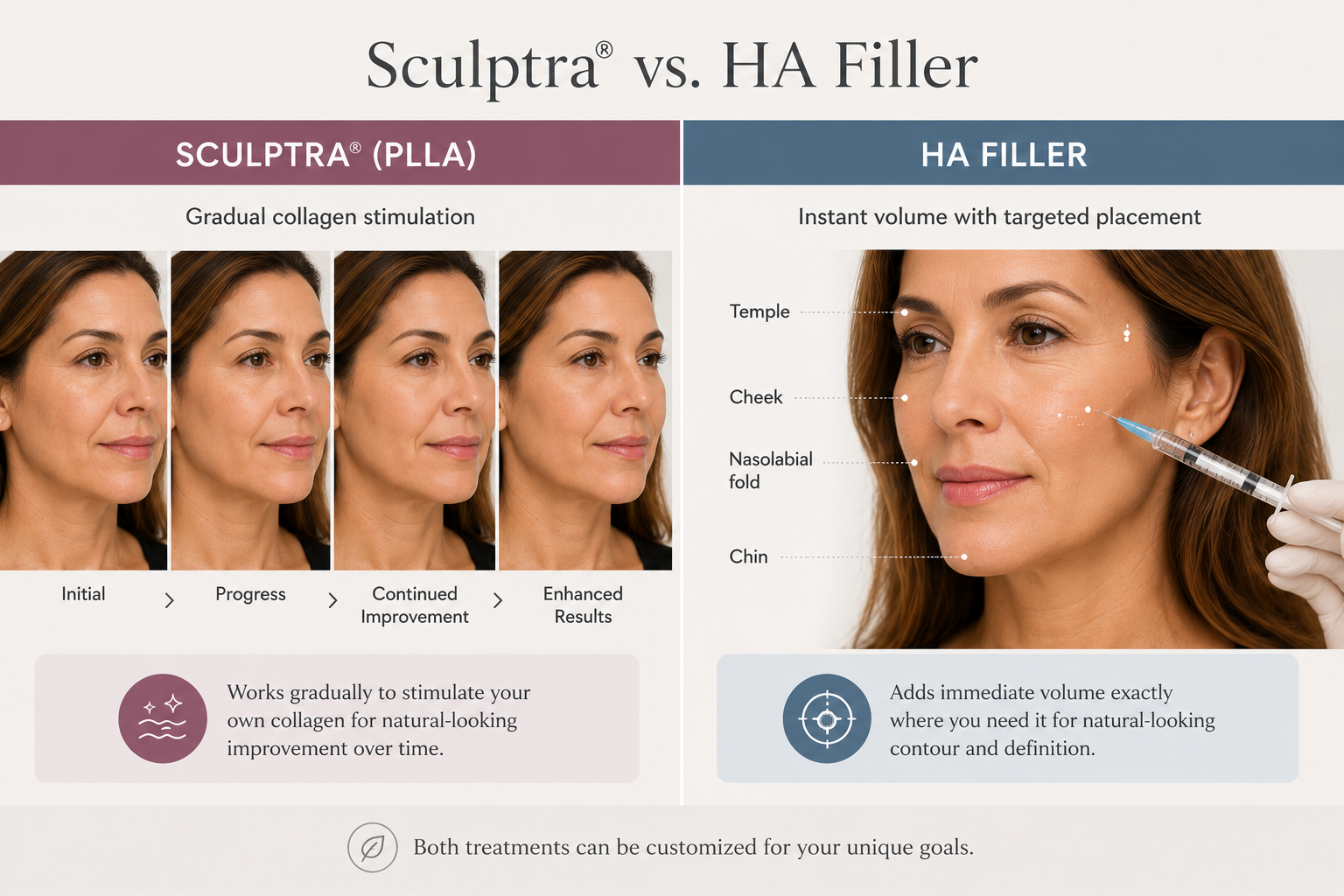
Sculptra is commonly described as a collagen stimulator or biostimulatory injectable because PLLA treatment is associated with a gradual tissue response rather than relying solely on the presence of a gel for its cosmetic effect.
This is one reason Sculptra's results develop differently from HA fillers.
However, “collagen stimulator” shouldn't be interpreted as meaning Sculptra can universally restore all collagen lost with aging or produce the same outcome in every patient.
The cosmetic response depends on the treatment plan, anatomy, number of treatments, product placement, and individual response.
Which Gives Faster Results: Sculptra or Dermal Filler?
If the goal is a more immediate filling or contouring effect, an appropriate HA filler generally produces visible volume sooner.
Sculptra is different.
PLLA effects become increasingly apparent over time, so Sculptra generally makes more sense for someone comfortable with gradual rather than immediate cosmetic change.
That doesn't make one approach better.
For example, someone wanting targeted lip augmentation has a very different goal from someone discussing gradual changes in cheek-region wrinkles.
The treatment should match the concern.
What Areas Can Sculptra Treat?
This is an area where marketing language can become misleading.
Sculptra shouldn't simply be advertised as an FDA-approved injectable for every area of the face and body.
The FDA's 2023 approval expanded Sculptra's aesthetic indication to the correction of fine lines and wrinkles in the cheek region in immune-competent adults.
If Sculptra is proposed for another cosmetic location or purpose, your provider should explain whether that use is off label.
This is especially important for body enhancement. The FDA recommends against using dermal fillers or other injectable fillers for body contouring or enhancement, including increasing buttock size.
At ME MEDSPA, treatment planning should therefore focus on the specific product, proposed treatment area, regulatory status, risks, and individual goals rather than assuming that every injectable can be used everywhere.
What Areas Can Hyaluronic Acid Fillers Treat?
The answer depends on the specific HA filler product.
FDA-approved dermal fillers have product-specific indications. Depending on the filler, approved uses can include selected:
Facial wrinkles and folds
Lips
Cheeks
Chin
Under-eye hollows
Jawline
The FDA emphasizes that approval for one filler or one treatment area does not automatically apply to every filler or every injection site.
Sculptra vs. Juvéderm: What's the Difference?
Sculptra and Juvéderm shouldn't be compared as though each name represents one interchangeable treatment.
Sculptra is based on PLLA.
The Juvéderm family includes HA filler products with different formulations and FDA-approved indications.
The practical distinction is again largely about the treatment objective.
An appropriate Juvéderm HA filler may be selected when a provider wants a targeted gel-based filling or contouring effect in an area for which that product is appropriate.
Sculptra produces a more gradual cosmetic response.
The right choice depends on:
Treatment area
Anatomy
Desired degree of correction
Whether gradual or more immediate change is preferred
Product-specific indication
Medical history
Previous injections
Provider assessment
Don't choose based solely on which brand is more popular.
Sculptra vs. Restylane: What's the Difference?
The same principle applies when comparing Sculptra with Restylane.
The Restylane family includes multiple HA fillers, and individual products are designed and approved for specific indications.
Your provider should be able to tell you the exact injectable being recommended, why it was selected, where it will be placed, and what type of outcome can reasonably be expected.
How Long Do Sculptra Results Last Compared With Fillers?
There isn't one duration that applies to every injectable.
The FDA describes PLLA effects as potentially lasting up to two years, while also emphasizing that filler duration varies by material.
HA filler duration also varies considerably depending on the specific product and injection area. The FDA notes that the duration of a filler's effect depends on both the material and where it is injected.
A better comparison uses the exact products and treatment areas being considered.
How Many Sculptra Treatments Will I Need?
There is no universal number appropriate for every patient.
PLLA is generally administered as a series of injections over time, but the appropriate treatment plan should be individualized.
The number and spacing of treatments can depend on:
Treatment goal
Anatomy
Area being treated
Baseline appearance
Individual response
Provider's treatment plan
Your provider should evaluate your response before recommending additional treatment rather than promising that everyone requires the same number of sessions.
How Many Dermal Filler Treatments Will I Need?
HA filler treatment planning works differently because the goal is often targeted correction or augmentation.
The amount of filler and whether additional treatment is appropriate depend on:
Specific filler
Treatment area
Anatomy
Desired outcome
Previous filler
Individual response
More filler isn't automatically better.
An appropriate treatment plan should aim for the desired cosmetic result while considering anatomy and product-specific safety information.
Can Sculptra and Dermal Fillers Be Used Together?
A provider may discuss different injectable products as part of a broader aesthetic treatment plan because Sculptra and HA fillers can address different cosmetic objectives.
However, this shouldn't be interpreted as meaning that everyone benefits from combining them.
The FDA notes that the safe use of dermal fillers in combination with other treatments has not necessarily been evaluated in controlled clinical studies.
Whether multiple injectable treatments are appropriate depends on the products, treatment areas, timing, anatomy, medical history, and provider assessment.
The goal should be a coordinated treatment plan—not simply adding more procedures.
Does Sculptra Have Downtime?
Injectable treatment can cause temporary reactions.
Depending on the product and treatment performed, reactions may include:
Swelling
Bruising
Redness
Pain or tenderness
Itching
Lumps or bumps
Other injection-site reactions
Dermal fillers can also cause less common or rare complications. One of the most serious is unintended injection into a blood vessel, which can cause tissue injury and, in rare cases, vision abnormalities, blindness, or stroke.
Is Sculptra Better Than Dermal Fillers for a Natural-Looking Result?
“Natural-looking” depends more on the treatment plan, anatomy, product selection, amount, placement, and individual response than on choosing one brand name.
Sculptra's gradual development can appeal to patients who prefer cosmetic changes that become noticeable progressively.
HA fillers can also create subtle, natural-looking results when an appropriate product and amount are used for the right treatment goal.
Both can produce results that look appropriate or inappropriate depending on how they're selected and used.
Sculptra vs. Dermal Fillers: Which Is Right for You?
The answer depends primarily on what you're trying to accomplish.
Sculptra may be worth discussing when the proposed treatment goal and area are appropriate for PLLA and you're comfortable with a gradual cosmetic response.
An HA filler may be considered when the goal involves more targeted filling, smoothing, or augmentation in an area appropriate for that specific filler.
Your provider should consider:
Facial anatomy
Treatment area
Type of cosmetic concern
Desired result
How quickly you want changes to appear
Previous injectable treatments
Medical history
Product-specific risks
Whether the proposed use is FDA-approved or off-label
The best treatment isn't necessarily the product that lasts longest or produces the fastest change.
It's the one that appropriately matches your anatomy and treatment goal.
Related Reading
Salmon DNA Facial in Monterey Park: The Regenerative Skin Treatment at ME MEDSPA
Thread Lift in Monterey Park, CA: Non-Surgical Face Lifting Without Downtime
Frequently Asked Questions About Sculptra vs. Dermal Fillers
Is Sculptra the same as filler?
Sculptra is itself categorized by the FDA as a dermal filler, but it differs from the HA gel fillers people often mean when they casually use the word “filler.” Sculptra contains PLLA and develops its cosmetic effect gradually.
Does Sculptra work immediately?
Sculptra's PLLA effects become increasingly apparent over time rather than functioning like an HA gel that provides an immediate filling effect.
Which lasts longer, Sculptra or dermal filler?
It depends on which filler is being compared. The FDA notes that PLLA effects may last up to two years, while filler duration varies according to the material and injection area.
Is Sculptra better than Juvéderm?
Neither is universally better. Sculptra uses PLLA, while Juvéderm includes multiple HA filler products. The appropriate option depends on the treatment area, desired cosmetic change, specific product indication, anatomy, and provider assessment.
Is Sculptra better than Restylane?
Again, neither is automatically better. Restylane is a family of HA fillers, while Sculptra uses PLLA. Treatment should be selected according to the specific concern and product being considered.
Can Sculptra be dissolved like HA filler?
Sculptra is not an HA filler and doesn't have the same type of hyaluronidase-based approach commonly discussed for reducing HA filler. The FDA notes that there are no specific reversal agents for semipermanent fillers such as PLLA.
Can I get Sculptra and HA filler at the same appointment?
That requires individualized medical assessment. Combining treatments shouldn't automatically be recommended simply because they work differently. Your provider should consider the exact products, areas, timing, anatomy, and treatment plan.
Are Sculptra and dermal fillers safe?
Both are medical procedures with potential benefits and risks. Common filler reactions include swelling, bruising, redness, pain, and tenderness, while uncommon but serious complications are possible. Product selection, anatomy, injection technique, and provider experience matter.
Book Your Consultation
Every face and treatment goal is different. At ME MEDSPA, your provider will evaluate your facial anatomy, areas of concern, previous injectable treatments, medical history, and aesthetic goals to determine whether Sculptra, dermal filler, or another treatment approach may be appropriate for you.
We welcome clients from Monterey Park, Alhambra, San Gabriel, Rosemead, and surrounding communities who are looking for personalized aesthetic treatments.
Ready to take the next step?
Schedule your consultation today to discuss the differences between Sculptra and dermal fillers and develop an individualized treatment plan based on your goals.

